Chapter-1
The Indian Railway Service of Engineers
The Romance of railways- There is a certain charisma attached to the railways. For a train traveler leaning out of window unfolds the exciting view of ever-changing landscape, the telegraph wires catenary, barefoot rustic children racing with the train and waving to the passengers, the country pathways cutting across the field, a village road crossing the track at a level crossing and the train looking back upon itself on a sharp curve. Otherwise, one enjoys swaying to the rhythmic clickety-clack sound, eavesdropping on subdued conversations, picking conversations with strangers to fashion shared experience, exchanging comics, and if nothing else getting immersed in deep thoughts. At stations a continual stream of vendors shuffling by the compartment, shouts of the police and the scramble among passengers leave imprint on the mind. For the dreamers it is manifestation of amazing power by a rumbling loco, the sight of a slow moving interminable goods train, the scratching & tug of couplings when the train is negotiating a curve, the melody of the wheels impacting the rail at a joint and the sound of desolate whistle of the loco during the eerie silence of night, that make the imagination soar up. Rarely there is an onlooker who watches a train passing by and does not cherish he was in it. My father was greatly fascinated by the railway. It was thus natural for me to get attracted to the railway service. I was a lecturer in Civil Engineering, Bihar College of Engineering, Patna when I appeared for the engineering services examination conducted by the UPSC. There was a prospect that I could be selected for the railway service. For the first time in Bihar a centre was allotted for this examination which was held in the gymnasium of the Science college, Patna. There were about 40 examinees. The invigilation was strict. The Principal (N.S.Nagendranath) himself made surprise rounds. I remember one question in the English paper:
Q. Find out the element of humour in the following:
-
An ambassador is a person who lies abroad for the sake of his country
-
The signboard on a chemist shop, ‘We dispense with accuracy’
When I received the call letter for viva-voce test, I sought guidance from me seniors at Bihar college of engineering, Patna. The two suggestions which aroused my curiously were as follows:
Q-1 What is Patna School of painting?
First I took it to be some school at Patna teaching fine art . But I was mistaken. When I visited Patna University library and borrowed a book on the subject I learnt that It was not a teaching institution as its name implied but a style of painting which flourished around Patna in the 18th and 19th century. The theme of this folk painting solely includes commoners (peddlers, fish sellers, basket weavers, bangle sellers, washermen, carpenters..), their lifestyle, bazar scenes, local festivals & ceremonies. Light coloured sketch, absence of background, development of shading in solid form and life like representations are mirrored in the paintings which astonish the viewers with their simplicity, explicity and proportion. The handful of artists from Danapur, Ara and Patna celebrated the cultural fabric of the colonial Patna which would have otherwise remained unnoticed and imaginary. The Britishers visiting Patna purchased these paintings as souvenirs. No wonder a good number of timeless showpieces of this art are currently displayed in British museums and adore the private houses abroad. The traditional art was ,however, destined to doom for reasons such as monotony, advent of photography and decline in local patronage. The art enthusiasts and impassioned admirers can have a glimpse of them in Patna Museum and Jalan museum.
Q-2 Why Biharis are called Budhus (fools)? Apparently such question may disturb the equanimity of the candidate but if he is imaginative he can outwit the Board by answering :” Because they come from the land of Budha.” The viva-voce was held at Kolkata. I put up at the residence of Sri Prem & Pyare Chandra Sinha who belonged to my mohalla (Mansa Pandey Bagh, Ara). They were staying at Dover lane. At Viva-Voce centre we waited for our turn in the ante-room where there were instructions: ‘Do not discuss with those interviewed earlier. Do not discuss your interview with others.’ A chart placed there showed the layout of the interview hall. As one enters, he faces the chair meant for him. Opposite him is the chair of the Chairmen. On the two sides were seated experts whose name and designation were described.
Following questions were asked from me: Q. You did your graduation from M.I.T. Muzaffarpur. What is this place famous for?
Q. What are the qualities of Muzaffarpur lichis which make it the best in India?
Q. What is the galaxy?
Q. In which part of the year it is clearly visible?
Q. How did Buddhism spread outside India? Through sea route or land route?
Q. What was the seat of Buddhism in Ceylon?
Q. What sort of dresses do Arabs wear?
Q. What is the colour of the dress and why?
Q. What is your hobby?
Q. What is bodyline bowling?
Q. Is that cricket?
Q. (lifting the paperweight and pretending to throw it with spin), which way the ball will turn after pitching.?
It was a prolonged interview. In between there was a coffee break. The members made me feel at ease. After the interview was over, I was asked to write down on a piece of paper the questions asked from me and the answers given thereto. All those who were interviewed were asked to undergo medical tests extending over two days. On the first day we were to report to the Eastern Railways B.R.Singh hospital at Sealdah for X-Ray and urine test. . On the second day we appeared in the office of the Chief Medical Officer, Eastern railway for eyesight test and detailed physical examination. Perhaps its location was the same where the Metro Railway Bhawan stands today. I came to know of the result only by chance. It was published in some Delhi newspaper. My MIT batchmate who happened to notice it informed me through a letter enclosing the paper cutting. We all were very happy. Yet the allotment of a particular service was not specified in the result. It only showed the names of all the services a candidate qualified for (i.e. IRSE, CPWD, CWPRS, CES-Roads etc.). Before long Father was summoned by the OC of Town thana entrusted with police verification for understandable purpose. This was succeeded by the receipt of the appointment letter from the Railway Board heralding my appointment in the IRSE. A First-Class A pass for my journey from Ara to Howrah was also enclosed. Two attendants in third class were also allowed in the pass, which in subsequent years was reduced to one. These were all bounties for me. I was overwhelmed that I was destined to join a highly sought-after service with admiration and unmatched respect attached to it. My Mother had always wished one of her sons to join the railway service and I was honoured to have fulfilled her dream. In the appointment letter I was directed to report to the GM, S.E.Rly, Garden Reach, Calcutta. I proceeded to Howrah by 12 DN (Delhi-Howrah Express) enjoying a first-class train travel for the first time in my life. From Howrah station it was a tram ride for Esplanade. There a number of buses were waiting for onward journey. They were getting filled in no time. It was a relief to come out of the crowded bus at the Garden Reach (called B.N.R. by the bus conductor). The majestic Headquarters building was complete with domes, turrets and portico. The ornate exteriors with a red brick façade imparted an elegant look to it . A swanky cast iron-Burma teak stair took me to my destination floor.


As directed in the letter I tried to enter GM’s chamber when I was stopped by the peon. On being told the purpose he showed me the chamber of the Secretary. The Secretary advised me to see the Chief Engineer. Here again I was intercepted by the peon and asked to meet the Personal Assistant (P.A.). It was not the end of pursuit as the PA led me to the chamber of the Dy Chief Engineer (General), Sri G.F.J. Lobo. The buck stopped there as Sri Lobo made me comfortable with his kind disposition. After signing the joining report, I felt pride and honour ,being part of a prestigious organization. Sri Lobo handed over to me certain books viz Safety first, Engineering code, General code, Way & Works manual etc. A First-Class A card pass was issued to me for unlimited travel over ‘Any to any station’ of the South Eastern Railway. Sri Lobo asked me to report to the Divisional Engineer (Construction), Tatanagar for training in yard remodelling and advised the concerned officer to arrange for my accommodation. It was in the Rest house within the circulating area of the station. Three more probationers of my batch also joined me.
 The subject
of yard remodelling did not enthuse us much. During the training one day I was taken ill. My batchmate (Y.
Ganesan) got me admitted in the Railway hospital. It was a general ward. Next morning Dr Panda visited the
ward. After completing his round, he asked if anyone had anything to say. I said," Yes. The milk supplied is
so diluted with water that it can hardly be called milk." The Doctor agreed to look into it. After he exited
the patients gathered around my bed and asked, " how dared you complain like this? If it were us, we would
have been maltreated." Then onward the quality of the milk improved . I thanked the doctor during his next
visit and in return received compliment from the fellow patients. For office training I had to attend
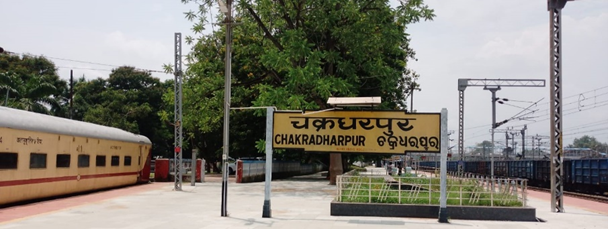
Chakradharpur Divisional office and the Headquarters at Garden Reach, Calcutta. After a couple of months I
received the order for training at the Railway Staff College, Baroda.
The subject
of yard remodelling did not enthuse us much. During the training one day I was taken ill. My batchmate (Y.
Ganesan) got me admitted in the Railway hospital. It was a general ward. Next morning Dr Panda visited the
ward. After completing his round, he asked if anyone had anything to say. I said," Yes. The milk supplied is
so diluted with water that it can hardly be called milk." The Doctor agreed to look into it. After he exited
the patients gathered around my bed and asked, " how dared you complain like this? If it were us, we would
have been maltreated." Then onward the quality of the milk improved . I thanked the doctor during his next
visit and in return received compliment from the fellow patients. For office training I had to attend
Chakradharpur Divisional office and the Headquarters at Garden Reach, Calcutta. After a couple of months I
received the order for training at the Railway Staff College, Baroda.